Pages

Showing posts with label video. Show all posts

Wednesday, December 30, 2015

JIGOKUDANI YAEN KOEN — Snow Monkey Park


While staying in Yokohama, my friend and I took a side trip for two days and one night to Jigokudani Yaenkoen, or Snow Monkey Park. It was one of the things I absolutely did not want to miss when I visited Japan so, despite the distance we went anyway. In fact, Jigokudani combines three of my favorite things: small animals, winter and baths. Although monkeys can be found throughout Japan the monkeys at Jigokudani are famous for relaxing in the area's natural hot springs. These monkeys are the only mammals in the world besides humans known to immerse themselves in hot water for recreation.

According to the park's website, after noticing that groups of monkeys were sitting in small hot spring pools during the winter, villagers worked to enlarge these pools and, as the same monkey groups returned year after year, began supplementing the monkeys' diets with grains during the winter. The park was born out of this connection and the regularity of the monkey tribe's movements has allowed scientists to study these monkeys more in-depth. The species to which these monkeys belong is that of Japanese Macaques and they are known to travel in large family groups under one king or leader. However, the website makes clear that these are still wild animals and tourists should be wary, especially when photographing or getting near mothers and babies.

The monkey park is located in the mountains around Nagano, a city north-west of Tokyo. Nagano is now known for its many ski-resorts, but long before the ski resorts or monkey park were drawing tourists this area's hot springs were a destination for Japanese vacationers. So, while traveling to see the monkeys, we took the chance to fulfill one of my other wishes: to visit a Japanese onsen (natural hot spring bath).


The town we stayed in was called Shibu Onsen. It was within walking distance of the monkey park and had only three or four streets lined from end to end with ryokan (traditional Japanese inns). This was a real onsen town, completely organized around the tourist industry with a few farms here and there. In my research I learned that there is a whole culture surrounding ryokan, whose closest western equivalents are bed and breakfasts. When staying at a ryokan you pay per person per night with the price being higher or lower depending on the number of tatami mats in your room (aka the room size) and the level of your meals (most ryokan I looked at had 2 or 3 levels of meals that you could choose from).

Most places were full by the time we were making our reservations, but we managed to book a 9-mat room at Senshinkan Matsuya Ryokan. We opted for breakfast and dinner at the first level which was delicious anyway. Both meals involved several courses including sashimi, miso, a meat dish, an egg dish, pickled fruit, noodles, rice, tea and dessert. We were only staying for one night, but it was enough to enjoy the peaceful austerity of the ryokan. The hostess offered us tea when we first arrived, showed us around our rooms and showed us how to take the bus to the snow monkey park. When we returned that evening our host asked us what time we would like to have dinner, then at 6:30 sharp, we received a call from the dining room telling us our dinner was served. I'm not much of a foodie, but trying all the different flavors in the meal was fun and the ryokan itself was a beautiful, old building.

The view from our room at Senshinkan Matsuya Ryokan.
Our tatami room at Matsuya included a kotatsu — a table with a blanket placed around the edge and a heat source underneath to keep you toasty while you sit.
The monkey park was everything we had hoped, but to get to it we had to take a local bus a few blocks and then hike through the forest up to the park's entrance. We happened to be there during a mild spell (travel blogs had warned us about freezing toes) so it wasn't cold, especially once we got moving. However, the deep snow drifts testified to colder weather and made the narrow path slippery. The path going up the mountain was about 4 feet wide and when groups of tourists passed each other going up and down they edge around each other in single files. I saw quite a few tourists slip and fall in the snow and it did not look fun. We passed quite a few Korean and Japanese families. a large number of European 30-somethings and a few other Americans who were confirming negative stereotypes by drinking beer and smoking cigarettes on the way down the trail. In a nature preserve! I was so mad. But they were leaving so we just avoided eye-contact and passed by.

At the beginning of our hike up to the snow monkey park.
The mountain was covered in tall, thin pines.
The park itself was not large, but the sheer number of monkeys running around and their indifference to humans made it well worth the hike. As soon as we walked in monkeys were running by us, grooming themselves in the trees and digging through the snow. Walking down to the hot springs we found monkeys bathing, including many mothers and babies, and a large herd of humans taking pictures expensive cameras. The monkeys did not care at all and most just enjoyed the hot water lazily. The babies were more curious, investigating their visitors and playing on the railings — one even ran over my boots!


After our hike back and dinner I wanted to go check out the baths that give Shibu Onsen its name. Shibu Onsen is home to 9 public hot spring baths and multiple ryokans, each of which has its own private baths as well. Residents of the town and those staying at ryokan are given a bathhouse key which unlocks the doors of every bathhouse in the town. Each bath is said to be beneficial for a different ailment and visiting all of them in order is said to give the bather good luck. I didn't have much time after dinner so I didn't go to all the baths. I decided to skip the ones labeled skin diseases and stomach sickness just in case. To go to the baths I put on my cotton yukata from the ryokan and grabbed a towel and bathhouse key. At first I tried to use the wooden sandals (the kind with two wodden slats on the bottom), but after stumbling in them for a block I went back and traded them for regular flip-flops, making the host laugh.
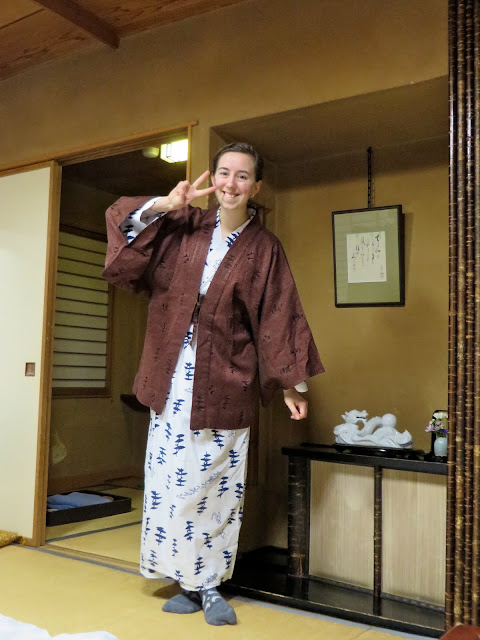
Trying on my yukata.
A typical public bath — most of the buildings were old and very simple. It's the water and not the decor that brings people to the onsen town.
All along the streets you could hear the rush of moving water — the sound of pipes channeling hot spring water to the baths. It really felt like something out of Spirited Away, walking at dusk with the snow and the water everywhere. I stopped in about 5 of the baths, each of which had a women's side and a men's side. Inside the entry-way was a sort of locker room with wooden cubbies for bather's possessions. Here you change out of your yukata before moving into the bath area. The baths all varied in size, but were uniformly scalding. Some were made of stone, others wood and all had vents opening right into the night sky to let out steam. Most also had a tap channeling cold water to adjust the temperature of the tub, but I tended to find that they made little to no difference in the heat. There was just too much hot water. At one of my stops some older Japanese women showed me how to rinse off using the wooden buckets on the floor before entering each bath. Most of the baths were much deeper and larger than Korean baths, making them fun to splash around in. I finally went back to the room sleepy and warm. The next day was an early series of trains back to Tokyo and visiting more friends there. 


How many snow monkeys can you spot?

Tuesday, September 22, 2015

Hiroshima


Atom Bomb Dome (Peace Dome), Hiroshima
We arrived in Hiroshima the in the evening, having said goodbye to the rabbits on Okunoshima earlier that day. I immediately liked the feel of the city which was a little old fashioned and slow. The train station was smaller than Osaka or Kyoto and full of elementary students in sailor uniforms. The students matched all the way down to their socks and up to their floppy hats.

Hiroshima is one of the few places in Japan that still has a street car system rather than a subway. Following the directions to our hostel, we got on one of the Hiroden line cars (1, 2, 6). We were taking the Hiroden line to Hacchoubori, where we needed to transfer to the Hakushima line. One quirk of the Hiroshima trolley system was the presence of uniformed conductors walking up and down the aisles asking people if they needed change. In order to transfer we paid for the ride on the Hiroden line and told the driver "To Hakushima, please," so he would give us a transfer card. The Hakushima line was very small, so we sat by the driver and watched him direct the trolley via a large switchboard.


Our hostel in Hiroshima, Guesthouse Roku, was wonderful — one of my favorite places we stayed. The guesthouse was in a traditional Japanese house and when we arrived the staff were chatting in the screened porch which doubled as dining room and bar. They were all very friendly and invited us to come down and have a drink after we got settled in.

View from my bunk at Guesthouse Roku. It was such a gorgeous old-style house and very comfortable too.
Narrow hallways at Guesthouse Roku.
That night we went out to taste Hiroshima's famous food — Okonomiyaki! For those of you who don't know, Okonomiyaki is a large layered pancake grilled in front of you on a giant steel slab. The basic ingredients are batter, shredded cabbage and green onions and from there anything goes. Common variations include seafood like squid or shrimp, other grilled meat, cheese, rice cake, vegetables or all the preceding. Delicious!

We only planned one full day in Hiroshima, so the next day we left early to see the Hiroshima Peace Museum soon after it opened at 9am. They day was alternately bright and drizzling as we walked through the Peace Park. The Atomic Bomb Dome was undergoing renovation when we visited, but was still impressive. Next to the Dome are photographs showing Hiroshima before the bomb was dropped and just days after. In the second picture, the dome is easily located as a single building in a field of rubble.

Anyone visiting Hiroshima and anyone interested in peace or war should visit the monument and the museum there. Using photos, artifacts, recreations and interviews the museum tells the story of that one day and its aftermath. The tone is never accusatory or angry, but documents the horrific results of the atomic bomb. Walking through the exhibits I felt that no distopian wasteland could be more terrible than the personal accounts I was reading. I learned that although the bomb did a lot of damage when it detonated equally terrible were the fires created from the reverse wind of the bomb.

We left the museum sobered, but also impressed by our interactions with the staff and volunteers who really seem committed to promoting peace around the world.


Thursday, June 12, 2014

FAMILY

I haven't checked in for quite a while and part of the reason behind this is that my family came to visit me in Korea. I was beyond thrilled and spent the better half of this semester masterminding a highly detailed 10 day itinerary for their trip.

I met them in Seoul on a Friday night and we stayed there until Sunday when we traveled to Gumi (my host city). In Seoul I mostly stuck to my favorite places — the National Museum, Insadong, Hongdae — but we also tried out a few new things. Best new discovery: the National Gugak Center (국립 국악원, gukrip gugakwon) has 1 hour live concerts of traditional Korean music every Saturday at 3pm. The best part? The tickets cost as little as 10,000 won. We saw court music, scholars music, a contemporary jazz piece composed for the Korean bamboo flute and an energetic drum dance. The only downside? No pictures allowed. 

Galbi (grilled marinated beef) dinner with my family and host family!
From left to right: My dad, host mom, Chaerin (host sister), Saeran (host sister), host aunt, host cousin, my brother, me, my mom, host grandma, host cousin
 We stayed in Gumi just two days as my family met my host family — a wonderful experience — and visited some of my classes. My students had to make questions for my parents. I can't decide which wins first prize: "Do you have a gun?" or "You're handsome, aren't you?" (directed to my father).

Busan night view, Haeundae beach, our first night
After Tuesday I was free for the week so we traveled to Busan, a nearby coastal city and also the second largest city in Korea. We stayed at Haeundae Beach, a popular tourist area, and took the City Tour Bus around to other landmarks like Taejongdae, Jagalchi Market and BIFF Square. If you've been to Busan, but haven't taken the City Tour I encourage you to do so. These double-decker buses (varying in quality from brand-new open-air to enclosed express bus style) will take you to every landmark in the city on a continuous figure-eight. For only 10,000 won you can get on and off as many times as you want, anywhere in the city all day. A great way to see a lot without struggling through a lot of subway or bus connections. 

Busan continued to drizzle, but we made the best of it
The other highlight of Busan has to be Spaland. We went to Spaland on the 7th day of our travels when everyone was starting to get grimy and correspondingly annoyed. I love jimjilbangs and have been to a couple that match Spaland for number of different relaxation rooms, saunas, and baths, but while including all these things, Spaland is far and away the most beautiful jimjilbang I have ever been to. The only drawback is the time limit of 4 hours (which can be extended to 6 if you spend at least 10,000 won inside the spa). I was a bit nervous how my family would feel about the totally naked baths (gender segregated of course), but they all loved it. In fact later in the trip whenever we were feeling tired, someone would always say, "Why don't we go to a jimjilbang?

Cheomseongdae, a Silla dynasty observatory, Gyeongju
After Busan we traveled on to Gyeongju, a much smaller town which is nonetheless a huge tourist destination for its multitude of historical landmarks. I'm not sure what we might have done if it rained, but thankfully the weather held out and we went walking, bicycling and hiking everyday there. We were staying in a traditional (hanok) style guesthouse and the cozy atmosphere was just right for the end of our trip. Almost too cozy as at first we couldn't even find the place. It wasn't until we took a taxi, walked in the rain with our suitcases and were picked up by a kind Korean man that we managed to find the place. In fact, I just asked this man for directions on the street because he looked friendly, but he took us into his stationary store where he read our map with a magnifying glass and then offered to drive us there in his car. Although it wasn't a situation you want to deal with when traveling I'm really glad my family got to see how kind Koreans can be. 

Bicycling in Gyeongju 
Visiting the remains of a fortress, burned by invaders
Hiking Namsan, known for numerous buddhist statues and cliff carvings
Since it was my birthday right before they arrived, my family brought my present with them — a new digital camera. My old camera was falling apart and the new one has some very cool functions including a hybrid video/photo mode. I used this hybrid mode to film some highlights from our trip and put them together to make the video below. Hope you enjoy it!