Pages

Showing posts with label KPop. Show all posts

Tuesday, September 29, 2015

Why Kpop?


This weekend is the start of Chuseok (Korean mid-fall holiday)! 추석 잘 보내세요! My friend invited me to celebrate the holiday with her and her Korean teachers who were having a Chuseok party/Korean conversation table this Friday. It felt a little awkward speaking Korean again, but I soon warmed up to the topic at hand: Kpop. One of the Korean teachers caught us watching Ikon's new music video and asked why we think so many international audiences love Kpop.

It's a question I've often asked myself: why is Kpop so addicting? The first answers that come to mind for most people are production value and talent. Korea's entertainment industry is highly competitive and regimented. Most groups produce few full-length albums, but many singles and mini-albums. Under this system, companies are able to throw huge amounts of money into a single music video. At the same time, artists train under a company anywhere from two to seven years before even debuting. The intensive training in singing, dance and grooming means every group has a certain level of excellence. These are all important aspects of Kpop's magnetism, but I think this answer is misdirecting — as our Korean teacher said, Bruno Mars is also a very talented singer and dancer.

Psy's "Gangnam Style" was not only wildly popular across the world, but is a prime example of Korean celebrity crossover. The music video features guest appearances by singer Hyuna and comedians like Yoo Jae Suk (Running Man) and Lee Hong Chul (Infinity Challenge).

Another answer can be found in Euny Hong's The Birth of Korean Cool, which came out in 2014 in the wake of Psy's "Gangnam Style." Personally, I have many problems with the book as it hastily glosses over many of the details and implications of the case studies it presents (perhaps in an effort to be published while still relevant — already in 2014 Psy felt like old news in the swiftly changing Korean pop-culture market). Hong answers the Kpop question with two words: government marketing.

She argues that Kpop has achieved the worldwide success it has due to aggressive government branding, intervention and support. As she notes, Korea has a ministry devoted to the promotion of Korean cultural products including Kpop. Besides financial support to help grow the industry (an action not as foreign as we in America might like to think, *cough* bailouts) Hong cites the compelling example of one Minister of Culture who traveled to Paris where he organized French Kpop fans into a cohesive group agitating for venues to book Kpop concerts in Paris. The issue was publicized through a Kpop dance flash mob which the Minister of Culture, and Hong, mark as a turning point in international demand for Kpop.

There's no denying that direct governmental interventions such as the case above have influenced the spread of Kpop, but it sidesteps the question of why people actually like Kpop. Even for the government to stir up demand there had to be an underlying interest.

One answer I've found is that Korean pop culture is built on a symbiotic loop that gives audiences access to idols in a constant variety of situations. In the U.S. actors turned singers and singers turned actors are both rare and rarely successful, but in Korea that kind of crossover is almost expected. By appearing regularly on variety shows, radio programs and in dramas and films idols allow fans to follow their story and build personal/emotional connections to their favorite stars. Singers in the U.S. sometimes follow similar methods (look at the huge success of the Justin Bieber documentary and continuing phenomenon), but the Korean entertainment industry is set up to support this kind of personal branding.

The cast of Roommate season 2 included singers, actors and comedians living together in a 'share house' and going on fun outings together. The show brought more widespread fame to rookie singers Jackson (GOT7) and Youngji (KARA).

Most variety and reality shows — Running Man, Roommate, Happy Together, I Got Married, Law of the Jungle, Hello Counselor (the list goes on and on) — either draw their cast entirely from idols or regularly feature idol guests. At the same time, music shows like Mnet Countdown, Inkigayo, Music Bank and Weekly Idol both support and rely on the quick turnover of Kpop singles. As a further illustration of the symbiosis between the two industries, many comedians and hosts will also release singles, further blurring the line between entertainer and singer.

Through youtube and social media fans are drawn into an ever expanding loop of interest. For example, a fan of 2NE1 might watch a variety program where members of 2NE1 appeared and enjoy the show so much that the fan begins to follow show itself. Drawing the example even further, that fan might then, in the course of watching their new favorite variety show be exposed to an idol who they find particularly funny and then begin listening to that idol's music. Television and music are always working together to increase each others' viewerships. It's an amazing system and prompts viewers to become invested in their favorite idols' lives and careers. To cite the Justin Bieber phenomenon again, its success and the success of Kpop both come from viewers' thirsts for personal celebrity connections.

In Win — Who is Next? Team A and Team B competed to see who could win over the audience and make their debut.
What this says about celebrity culture and human relationships in the 21st century is a question I would love to learn more about, but instead I want to leave you with a recommendation for what I think is one of the most successful examples of Kpop fanbase creation: Win — Who is Next?

Win was produced by YG Entertainment as a survival competition between two groups of trainees. In the end the show asked the viewers to vote on which group they wanted to see debut the most. Eventually both groups debuted, although the group that lost had to go through another round of survival tv before that. Through this show the resulting Kpop groups — Winner and Ikon — were able to debut with large fanbases devoted to their hopes and struggles.

Thursday, September 10, 2015

응답하라1994 ~ Answer Me 1994


One of my favorite dramas of all time is Answer Me 1994. I watched it first in the winter of 2013, soon after it first aired and again in 2014. Answer Me 1994 is a comedic, light-hearted drama that follows the growing pains of 7 young college students in 1994, all of whom recently moved to Seoul from the countryside. At that time Seoul was (as it still is now) the major city in Korea, but even more than now, other parts of the country were still relatively under-developed, lacking many of the western chains that are ubiquitous today.

One of the reasons I love this drama is that it is essentially nostalgic — it is meant to appeal to viewers who grew up in that time period and to evoke the decade when Korea (and the whole technology world) were changing rapidly. The drama does this masterfully and helped me understand where certain aspects of 21st century Korea have arisen from.

Although all the characters have entertaining storylines, the main plot revolves around Sung Na Jung (Go Ara) and her future husband. The drama involves a frame story set in 2013 in which Sung Na Jung has just moved to a new apartment. The doorbell rings and through the door camera we see all the members of Na Jung's college hasukjip (homestay or boardinghouse). In a voice over Na Jung tells the audience that one of the men below is her husband. From there on, each episode contains a small portion of the frame story and then flashes back to the characters' college days as they reminisce.

So what do I love so much about Answer Me 1994?
  • This is one of the best written dramas I have watched. The characters come off as natural, sometimes goofy and very likeable. There are no real villains and conflict comes mostly through the coincidences of life rather than any fatal misunderstandings.
  • Go Ara does amazingly well portraying the outspoken, passionate and sometimes insecure Na Jung. Sung Il Dong and Lee Il Hwa have wonderful roles as Na Jung's father and mother respectively. The rest of the main cast — Jung Woo, Yoo Yeon Suk, Kim Sung Kyun, Son Ho Jun, Baro (of B1A4) and Min Do Hee (of TinyG)— are all at times hilarious, pitiable and charismatic.
  • The drama provides a special glimpse into the Korea of the 90s. You can watch the rise of college sports and kpop with their respective fandoms, the feelings surrounding the IMF crash (when Korea declared bankruptcy) and the rivalry between Seoul and the other provinces.
This is one drama I can watch again and again and the characters and situations never get old.

Friday, September 4, 2015

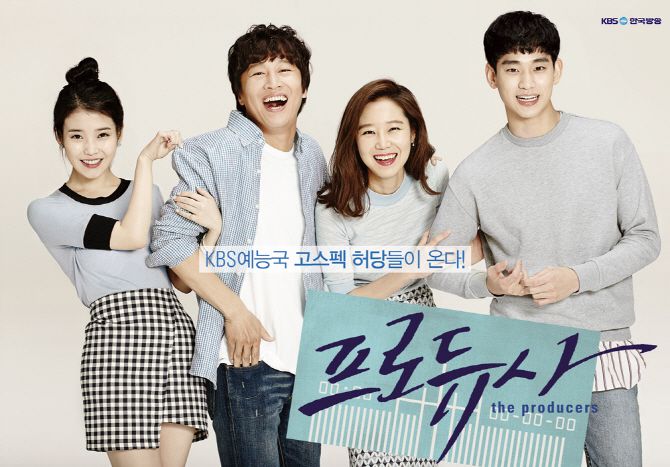
프로듀사 ~ PRODUCER


This summer I took the opportunity to watch the star-studded drama, Producer, which came out in the late spring of this year. The story follows Baek Seung Chan (Kim Soo Hyun) a rookie in the variety department at KBS, Tak Ye Jin (Gong Hyo Jin) the producer of Music Bank, Ra Joon Mo (Cha Tae Hyun) the producer of 1 Night, 2 Days and Cindy (IU) a popular singer as their professional (and love) lives overlap.

The story opens with the slightly clueless Baek Seung Chan who followed his college crush to KBS's variety department, only to discover on his first day that she is dating one of his sunbaes. At the same time, Tak Ye Jin, famous in the variety department for her temper, is having money troubles and dented a car on the way to work, but can't get in touch with the owner all day. Not only that, the star Cindy, who is appearing on Music Bank that evening refuses to change out of a risque outfit. Ra Joon Mo is having troubles of his own: his show ratings have reached the lowest of the low and the rumor is going around that 1 Night 2 Days will be cancelled very soon.

By the end of the first episode we discover that the car Tak Ye Jin hit is in fact Seung Chan's car, the man dating Seung Chan's crush is Ra Joon Mo, who's show is, in fact, getting cancelled and Joon Mo is actually Ye Jin's childhood friend and POTENTIAL SPOILER: roommate.

If you noticed I didn't mention IU too much it's because she doesn't figure too heavily in the opening of the story. At its core, Producer is a drama about growing/changing relationships, especially in the face of the media and media culture. Cindy (IU), is cold, isolated and overworked. At the age of 23 she has been active in the industry for 10 years and has no friends. Over the course of the drama she struggles with all these issues and we could say her coming of age is the main storyline.

In fact, there are many different main storylines all of which are roughly equally balanced within the drama. For some people, especially those who prefer to watch only the main romance, this could be a drawback to Producer. The show is somewhat experimental within the kdrama genre and did not do as well in Korea as the popularity of the main actors/actresses might have predicted.

However, there are many things to love about Producer as well:

  • The four main stars (Kim Su Hyun, Gong Hyo Jin, Cha Tae Hyun and IU) all had wonderful performances. As a group the actors had wonderful chemistry resulting in some very hilarious scenes in which Gong Hyo Jin and Kim Su Hyun perform their best (or possibly worst) aegyo. 
  • The drama is FULL of cameos. Even many very small characters are easily recognizable stars. Just trying to find out who's who and get in on the joke can be a lot of fun. Look for Girl's Generation, JYP, Hani of EXID, Dara of 2NE1, Kang Seung Yoon of Winner, Lee Seung Gi and many others.
  • You get to peek into the world of Korean variety television. All of the work scenes are filmed right in KBS and the scenes in which the producers come up with ideas, test-run games and edit the raw footage are often hilarious, while being true to life.
  • Again, the actors really made the drama. Besides that, the show only lasts 13 episodes and who doesn't have time for that?

Thursday, October 9, 2014

FALL HOLIDAYS

It's nice to check in after a long time. I've been enjoying the new semester at Dongdo Middle School and getting back into life in Korea. Living in an apartment has taken some getting used to, but after some time I now look forward to coming back to my home after school, turning on the rice cooker and settling down to do a little work or watch some tv.

We've had several holidays since I've been back at school. First in September we had Chuseok, a Korean harvest festival during which many Korean families perform ancestral rites and eat a lot of food together. Then last week we had a three day weekend and this week I haven't gone in to school at all due to a combination of midterm exams and vacation days. 

When Chuseok came around back in September I was in the middle of studying for the GRE subject test in literature. I had no spare brain space to make any plans for the long weekend and was, in fact, still unpacking some of my bags. Instead of making plans I sent my host mom a text message that Sunday asking her if there was some time I could come visit that week. I got the reply right away, "We are at home today! Come any time!" I hadn't been expecting to go quite so soon, but grabbed my purse and went straight to Dong Daegu train station. Chuseok is a notoriously bad time for traveling because everyone is trying to go see their families. However, the train station was not bad and after 40 minutes of loitering in the cafe car I found myself back in Gumi and catching the familiar bus to Shinpyeong. I spent the afternoon there with my host mom and sisters, watching tv, eating ceremonial food and peeling various vegetables. It was as if I had never left. I went home that evening, but they invited me back for a big lunch the next day. This time I was able to see my host cousins. Jun Hyun has started going to an English hagwon and his parents wanted to show off his new English skills. "Long time no see." He followed this up with a long litany of baseball teams and body parts: "Lions, Twins, Elbow, Eagles, Hand." I tried playing tag with the boys outside, but it was beastly hot and they talked me into buying ice cream instead. In the CU I wondered what the cashier thought as a random foreigner argued with two young boys in broken Korean. No, you have to choose one, the juice or the ice cream; no I am not buying you gum as well. It was sweet seeing them all again, seeing how sedately their lives go on.

The next three day weekend found me back in Gumi again, this time to see my friends. I had been meaning to get back to board game club for some time because I had a new game I wanted to try out "Resistance." Basically it sounded like a more intense version of mafia and great for a large group. In fact, it was both those things. However, it was also a terrible game to play with a highly competitive group of friends. After two rounds we really needed to unwind and finished the night by playing drinking games while watching The Room. I love cozy nights like this, surrounded by people I like. Nights like this can be hard to come by living alone in a foreign country, but I've been so lucky in all the people I've met here. 

I stayed over with my friends that night because the next day we were all going to the LG Dream Festival. As the name implies it's a celebration of LG including a local talent show ("Dreams do come true") and culminating in a big name KPop concert. We arrived at the stadium around 1pm in order to grab prime seats. It was a perfect day to be outside with a clear bright sun shining over the edge of the stadium walls. It was a real festival atmosphere with a booths selling fried foods, stilt walkers making balloon animals, carnival games to win packs of ramen and robot exhibitions by LG. We lounged our way through the afternoon performances which began at 4pm. Then began waiting anxiously for the Kpop to arrive. There was a long, patriotic rally for LG which promised to be interminable, except that the staff began handing out giant paper lanterns to members of the crowd to send into the sky. I've been wanting to send off one of these lanterns ever since I saw a picture of Taiwanese New Year's celebrations. One of my friends made a commotion and we soon got a lantern. It was about the size of a medium size suitcase, made of pale paper with a thin wire base where a piece of unburning paper provided the fuel. We held it together on all sides. It was much harder to do than I expected as the wind threatened to collapse the dome and sent sprays of hot fire licking around our hands. I saw smoke rising around the crowd and several people had their lanterns taken away in flames. However, as a gust of wind tugged the lantern we agreed "Let it go!" and sent it off into the air. We watched it rise up over the crowd, past the floodlights until it disappeared. My friend thought it crashed, but I think it just floated further than we could see. Hundreds of lanterns were still being raised around the stadium. One didn't catch a big enough burst of wind and went skimming over the heads of the crowd until one brave high schooler pushed it further up into the air. 

Later we saw Vixx, BAP, AOA and B2ST. Each group performed three or four of their most popular songs and did a short interview for the crowd. None of the groups were my favorite, but seeing them was still a lot of fun and the dancing was awesome. I knew somewhere in the crowd my host sister was going crazy. BAP is her favorite, favorite group and she got special tickets close to the stage just to see them. 

In a quick turnaround I met up with two of my Fulbright friends in Busan the day after the concert for the Busan International Film Festival. I missed this festival last year and knew I couldn't miss it again after hearing stories from my friends who had gone. Perhaps one of my favorite things about now living in Daegu, I was able to take the KTX (Korea's high speed train, 300km/hr) from Dong Daegu Station to Busan in just about 45 minutes. It took about another hour on the subway to meet my friends and then we bought tickets for that day: a Korean film called Venus Talk and a Vietnamese film called Gentle. Both movies were showing in the Shinsegae theater at Centum City, the largest shopping mall in Asia. Venus Talk turned out to be a Korean style Sex and the City following three middle aged women as they navigate their increasingly complicated sex lives. My friends and I loved it. After the showing the director and three main actresses came on stage for an interview and photo shoot. 

The second movie was darker and more experimental. The director was born in Vietnam, but raised all his life in America. When he was 26 he went back to visit Vietnam for the first time and since then has spent a great deal of time there. The movie we saw, Gentle, was his third film made in Vietnam. It was based on a short story by Dostoevsky in which a widower reminisces over his married life while sitting next to his wife's corpse. The wife has committed suicide and throughout the movie the widower reveals the ways in which his own arrogance and weakness led to her death. Like any good Dosteovesky story it is subtle and full of religion. Interestingly, the director told us that reading this story for the first time he had such a strong sense that it was a Vietnamese story that he had to make the film. 

After all the movies and interviews it was late enough for dinner. We went back to our hostel so I could drop off my backpack and got dinner at one of the nearby grill restaurants where we ate some mediocre beef. Then we hung out on the beach listening to the live music that must have been part of the festival. On the beach with the wind it was very cold. Eventually we met up with some other fulbrighters and talked for a long time before heading to bed. 

Our final day in Busan we checked out of the hostel and got tickets for one more movie: a Spanish film called Magical Girl which we hoped would be quirky and charming. It was anything but. Although it opened as promised with the daughter, dying of leukemia and her obsession with the Japanese anime character Yukiko, the relationship of father and daughter soon became a secondary concern of the film as the diegesis focused further and further on the bizarre woman Barbara who the father attempts to blackmail in order to buy his daughter a magical girl outfit. The plot which had sounded so goofy at first vacillated between implied sexual abuse, the corruptions of the spanish government, mental illness and prostitution. We left the theater feeling stunned and a bit trampled. 

To cure ourselves we went to Spaland, my favorite place in Busan, where we ate lunch at the spa restuarant, nearly fell asleep in the relaxtion rooms, soaked in the baths and received full body scrubs from professional ajummas in black lace lingerie. It was my first time getting the full body scrub and it. was. great. It was like getting a massage except at the same time I could see beads of dead skin rolling off of my body in great swirls. I can't tell if my skin is more glowing now, but it does feel marvelously smooth. After our scrubs we rinsed once again and parted ways.

The rest of this week has been wonderfully restful. On Monday I visited my old school in Gumi. I had a kalguksu lunch with Jung Nam Suk and my ajumma friends, practiced my Korean and gossiped over coffee. That evening I went back to Daegu for my first NKD meeting of the semester. Wednesday was Club Day for our school so I joined my coteacher, Hyeon Young, and her club class to make choco muffins. I worked with the third graders who were very silly. We ended the afternoon at Beomeo Library where I found a really wonderful collection of English books. I don't have a library card yet, but I sat down that afternoon and, with no classes Thursday or Friday, read The Interpreter of Maladies by Jhumpa Lahiri. Looking forward to visiting that place much more often in the future. 

Wednesday, July 17, 2013

KPOP

So last week we learned the dance to the popular KPop song What's Your Name? by 4 Minute and since then I've been watching KPop videos non-stop (for immersion purposes of course). Boy bands are alive and thriving in Korea. I love it. My favorite at the moment is Big Bang, especially their dramatic Haru Haru and the classic feel of Bad Boy. Some of the connoisseurs here have also introduced me to Exo-K and the serious questions of What is Love? I haven't listened to the girl groups as much, so that's my homework. For now, I just really like this Lee Hyori song: Crazy. I'm interested in how the video plays with gender norms, while admitting its own place within that structure. I can't decide if the video is subverting or reinforcing the gender roles it depicts. Interesting too, since some gender signifiers such as touching and personal appearance vary slightly from the U.S. to Korea.