Pages

Showing posts with label photos. Show all posts

Wednesday, December 30, 2015

JIGOKUDANI YAEN KOEN — Snow Monkey Park


While staying in Yokohama, my friend and I took a side trip for two days and one night to Jigokudani Yaenkoen, or Snow Monkey Park. It was one of the things I absolutely did not want to miss when I visited Japan so, despite the distance we went anyway. In fact, Jigokudani combines three of my favorite things: small animals, winter and baths. Although monkeys can be found throughout Japan the monkeys at Jigokudani are famous for relaxing in the area's natural hot springs. These monkeys are the only mammals in the world besides humans known to immerse themselves in hot water for recreation.

According to the park's website, after noticing that groups of monkeys were sitting in small hot spring pools during the winter, villagers worked to enlarge these pools and, as the same monkey groups returned year after year, began supplementing the monkeys' diets with grains during the winter. The park was born out of this connection and the regularity of the monkey tribe's movements has allowed scientists to study these monkeys more in-depth. The species to which these monkeys belong is that of Japanese Macaques and they are known to travel in large family groups under one king or leader. However, the website makes clear that these are still wild animals and tourists should be wary, especially when photographing or getting near mothers and babies.

The monkey park is located in the mountains around Nagano, a city north-west of Tokyo. Nagano is now known for its many ski-resorts, but long before the ski resorts or monkey park were drawing tourists this area's hot springs were a destination for Japanese vacationers. So, while traveling to see the monkeys, we took the chance to fulfill one of my other wishes: to visit a Japanese onsen (natural hot spring bath).


The town we stayed in was called Shibu Onsen. It was within walking distance of the monkey park and had only three or four streets lined from end to end with ryokan (traditional Japanese inns). This was a real onsen town, completely organized around the tourist industry with a few farms here and there. In my research I learned that there is a whole culture surrounding ryokan, whose closest western equivalents are bed and breakfasts. When staying at a ryokan you pay per person per night with the price being higher or lower depending on the number of tatami mats in your room (aka the room size) and the level of your meals (most ryokan I looked at had 2 or 3 levels of meals that you could choose from).

Most places were full by the time we were making our reservations, but we managed to book a 9-mat room at Senshinkan Matsuya Ryokan. We opted for breakfast and dinner at the first level which was delicious anyway. Both meals involved several courses including sashimi, miso, a meat dish, an egg dish, pickled fruit, noodles, rice, tea and dessert. We were only staying for one night, but it was enough to enjoy the peaceful austerity of the ryokan. The hostess offered us tea when we first arrived, showed us around our rooms and showed us how to take the bus to the snow monkey park. When we returned that evening our host asked us what time we would like to have dinner, then at 6:30 sharp, we received a call from the dining room telling us our dinner was served. I'm not much of a foodie, but trying all the different flavors in the meal was fun and the ryokan itself was a beautiful, old building.

The view from our room at Senshinkan Matsuya Ryokan.
Our tatami room at Matsuya included a kotatsu — a table with a blanket placed around the edge and a heat source underneath to keep you toasty while you sit.
The monkey park was everything we had hoped, but to get to it we had to take a local bus a few blocks and then hike through the forest up to the park's entrance. We happened to be there during a mild spell (travel blogs had warned us about freezing toes) so it wasn't cold, especially once we got moving. However, the deep snow drifts testified to colder weather and made the narrow path slippery. The path going up the mountain was about 4 feet wide and when groups of tourists passed each other going up and down they edge around each other in single files. I saw quite a few tourists slip and fall in the snow and it did not look fun. We passed quite a few Korean and Japanese families. a large number of European 30-somethings and a few other Americans who were confirming negative stereotypes by drinking beer and smoking cigarettes on the way down the trail. In a nature preserve! I was so mad. But they were leaving so we just avoided eye-contact and passed by.

At the beginning of our hike up to the snow monkey park.
The mountain was covered in tall, thin pines.
The park itself was not large, but the sheer number of monkeys running around and their indifference to humans made it well worth the hike. As soon as we walked in monkeys were running by us, grooming themselves in the trees and digging through the snow. Walking down to the hot springs we found monkeys bathing, including many mothers and babies, and a large herd of humans taking pictures expensive cameras. The monkeys did not care at all and most just enjoyed the hot water lazily. The babies were more curious, investigating their visitors and playing on the railings — one even ran over my boots!


After our hike back and dinner I wanted to go check out the baths that give Shibu Onsen its name. Shibu Onsen is home to 9 public hot spring baths and multiple ryokans, each of which has its own private baths as well. Residents of the town and those staying at ryokan are given a bathhouse key which unlocks the doors of every bathhouse in the town. Each bath is said to be beneficial for a different ailment and visiting all of them in order is said to give the bather good luck. I didn't have much time after dinner so I didn't go to all the baths. I decided to skip the ones labeled skin diseases and stomach sickness just in case. To go to the baths I put on my cotton yukata from the ryokan and grabbed a towel and bathhouse key. At first I tried to use the wooden sandals (the kind with two wodden slats on the bottom), but after stumbling in them for a block I went back and traded them for regular flip-flops, making the host laugh.
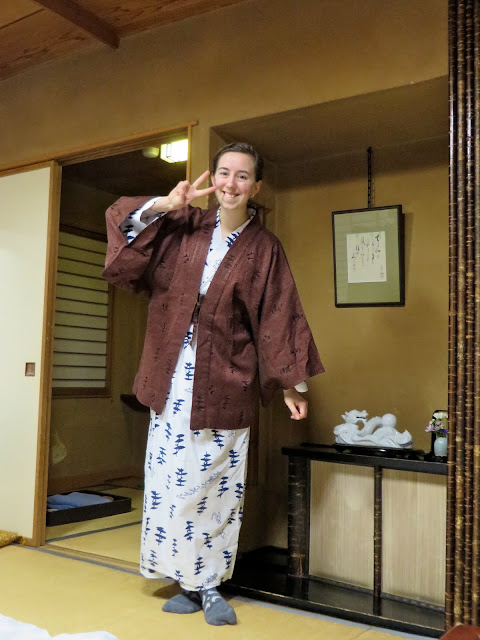
Trying on my yukata.
A typical public bath — most of the buildings were old and very simple. It's the water and not the decor that brings people to the onsen town.
All along the streets you could hear the rush of moving water — the sound of pipes channeling hot spring water to the baths. It really felt like something out of Spirited Away, walking at dusk with the snow and the water everywhere. I stopped in about 5 of the baths, each of which had a women's side and a men's side. Inside the entry-way was a sort of locker room with wooden cubbies for bather's possessions. Here you change out of your yukata before moving into the bath area. The baths all varied in size, but were uniformly scalding. Some were made of stone, others wood and all had vents opening right into the night sky to let out steam. Most also had a tap channeling cold water to adjust the temperature of the tub, but I tended to find that they made little to no difference in the heat. There was just too much hot water. At one of my stops some older Japanese women showed me how to rinse off using the wooden buckets on the floor before entering each bath. Most of the baths were much deeper and larger than Korean baths, making them fun to splash around in. I finally went back to the room sleepy and warm. The next day was an early series of trains back to Tokyo and visiting more friends there. 


How many snow monkeys can you spot?

Tuesday, April 29, 2014

HANOI: Part II

Not too much has happened the last few weeks. My Korean class at the local English-language church ended and then this last weekend I went up to Seoul for our Infusion magazine meeting. Infusion is the literary magazine published by Fulbright Korea. I have been working as a staff editor for the magazine since this fall. Now my students are taking their midterm exams so I have a bit more free time. I want to take advantage of this lull to post the rest of my pictures from winter break and the gorgeous Vietnamese scenery.

Outside of Hanoi we took a ferry around Halong Bay, famous for its numerous rocky projections.
Throughout the bay are floating fishing villages. We stopped at one to rent kayaks and paddle around.
#kayakselfie

Another day we traveled a little north of Hanoi to an old capital of Vietnam. The area is described as the 'dry Halong bay' because it contains the same rocky formations.
Entrance to an old temple. This temple was unique in having been built entirely by the local population without regulation or support from any government or ruler.

Later in the day, at a different site, we rode row boats along the river.
I'm sure a large part of the local income comes from this tourism. The scenery was beautiful, but it was uncomfortable being rowed around by a woman older than my mother. 
In the last moments of our day we went bicycling  around the fields.


Sunday, April 20, 2014

Mid-March Blues and Yellows

Today was the first day I felt well enough to go to yoga in two weeks. Today was a beautiful day, a mid-April day. How can it be mid-April already? The afternoons are so warm here now, sunny and breezy. When I looked at my calendar I almost cried because there is so little time left. I'm ecstatic to be healthy (or almost healthy) again and I plan to stay this way for the rest of the grant year (knock on wood).

A lot has happened since mid-March but most of it involved me coughing, sneezing and oozing. The highlights include: seeing Lee Seung Chul live in concert with my host sisters! Lee Seung Chul has been popular for ages. His most recent single and one of my favorite noraebang songs is My Love. When my host sisters found out he was coming to Gumi they booked our tickets immediately — my first time ever as a VVIP. We were maybe 15 rows away from the stage and had a great time singing, dancing and waving flashing wands. At the end of the concert several ajummas (ladies of a certain age) stood on their chairs and refused to leave the hall, yelling "Oppa! Oppa!"(Oppa is the word Korean women use for an older male friend. Literally translated its meaning is close to 'older brother', but the word is equally appropriate when used to address an older boyfriend.)
At the concert these flashing star wands are almost obligatory.
The week after the concert the cherry trees blossomed letting us know spring is finally here to stay. I visited the Geumosan trail with my host mom to admire the flowers and take some pictures.


Just as I was starting to feel better it was time to fly to Jeju for our Fulbright Spring Conference. Weather there was windy, cold and bright. It reminded me a lot of San Francisco. It was good to see all the other ETAs again, even people who I hadn't spoken to since the last conference, and we had a great time exploring Jeju island. Unfortunately our last evening I got food poisoning, so getting back to school after conference was quite difficult. 
View from Halla Mountain in Jeju.

Catching up with friends :)

It was extremely windy and cool all weekend.
After several doctor's visits I'm finally over everything except some lingering allergies. I had been feeling down, thinking how much time I wasted being sick. However, looking back now I can see how many fun moments I've had in the last month despite feeling under the weather. It's an important lesson to remember as this grant year rushes to a close, often we are doing more than we believe. It's also a good reason to keep recording, here on the blog or in my journal, because sometimes it provides a more honest perspective than my memory.


Saturday, March 15, 2014

HANOI: City of colors

We arrived in Hanoi mid-afternoon on an early morning flight from Taipei. We had applied for visas on arrival, so after getting off the airplane we went to a separate immigration post to pick them up. The process took about 10 minutes and then we continued through the regular immigration checkpoint and on to get our luggage. The Hanoi airport is around 40 minutes from the city center so we took a taxi from the airport to our guesthouse in the Old Quarter.

Old Quarter Hanoi has become a hub for backpackers of all kinds, but despite that reputation it has not become overwhelmingly commercial. There are many travel agencies, restaurants and bars in the area that clearly cater to tourists, but these businesses co-exist within the city's particular character. Sometimes a place that caters to tourists can feel dry and lifeless — Hanoi's old quarter is anything but. Thinking of Hanoi I will always think of movement, that sea of motorbikes, and the bright red, green, yellow of the buddhist flags.

The Hanoi Guesthouse where we stayed was a little more expensive than some at $20 a night, however the price was well worth it for the delicious breakfast and kind staff. It is quite likely the friendliest hotel or guesthouse I have stayed at in any country. Each morning we had our choice of coffee, tea or fresh juice and crepes, cereal, pho or fried sticky rice. My favorite was the fried sticky rice, covered with crispy little onions; I ate it almost every day.

The view from our room at Hanoi Guesthouse.
Looking back I wouldn't have stayed anywhere but the Old Quarter. Its streets were always crowded with pedestrians and motorbikes, but it was the endless crowding of street upon street, cafe upon cafe and alley upon alley that made this tortuous neighborhood so invigorating. The tumult of people and buildings was punctuated by sudden moments of calm in the form of a courtyard full of birds or a vacant coffee shop sitting like a gaping mouth on the edge of the road.

The Old Quarter's ubiquitous motorbikes.

Old Quarter intersection: cafes on cafes.
I mentioned that Hanoi was a city of colors, but I didn't add that it was also one of the most beautiful places I have ever been. Part of Hanoi's beauty came from the architecture itself which was a hodge podge of windows, balconies and unfinished arches. Coming from a place where the world is built inwards against winter it was lovely to see a whole city built to enjoy the breezes and open air. This image was reinforced in my mind by the habit of keeping birds about houses and stores. These songbirds added so many extra dimensions of loveliness to a building through their voices and through the simple fact of their being alive. I learned later that raising songbirds is a traditional art in Vietnam, generally practiced only by men. Thus, people say you can judge the character of a man by the health and care visible in his songbirds.

Old Quarter birdcage.

Birds in the courtyard of an Old Quarter craft house.
Many of the things I loved most in Hanoi I never meant to find. The birds were one and this craft house was another. An immensely peaceful building it was a communal craft house at a time when the Old Quarter was a hub for traditional handicrafts rather than tourists. The city's craft houses were repurposed during the French colonial period and many have now been reopened as showcases or temples.

View inside the craft house turned temple.
Other discoveries included: this man carrying a kumquat tree on the back of his motorbike,


students behind St. Joseph's Cathedral,


and this wall art depicting the legend of Hoan Kiem lake.


'Hoan Kiem' means 'heavenly sword' and Hoan Kiem in the past was said to be the home of giant turtles, one of four mythical animals. I love the strange suspension and animation between the waves, clouds and lotus blooms.

We happened to be in Hanoi about a week before the Lunar New Year and so, got to see a bit of Vietnamese tradition and culture firsthand. As in Taipei, markets here were preparing for the new year with effusive red and gold stalls, envelopes and candy. However, on our third day in Hanoi we saw something a little different. We were waiting in the lobby of our hotel to go on a day trip outside the city when a women arrived by motorbike delivering, not fruit or bread, but three bright red fish swimming in a plastic bag. The hotel staff explained to us that in Vietnamese tradition there are three spirits related to the home — one in the kitchen, one in the whole house and one in the local area. One day a year before the Lunar New Year these three spirits go to Heaven to report on the household. Each household or business then keeps three red fish outside their home on this day for the spirits to ride to Heaven.


If you can't tell already I was captivated by Hanoi and from the first day we arrived there to the last I felt like I had to return again.

Tuesday, February 18, 2014

TAIPEI PART III: the Maokong Mountains


By far, the best thing we did in Taiwan was our journey to the end of the MRT line and the gondola across the Maokong Mountains. It was our last day in Taipei and taking the gondola was a whim, a small dot at the end of the map next to the Taipei Zoo. I'm not sure I mentioned before, but the Taipei metro system is quite beautiful. The line to the zoo is elevated, much like the L in Chicago. As we sat on the train for the twenty minutes it took to reach the end of the line I felt so peaceful, tall houses and trees gliding by.

The last stop was full of small children and high school couples visiting the Zoo on a Saturday afternoon. We passed them by and continued three or four blocks to the gondola which was only 50 TWD each way (about $1.75). I had expected the gondola to go from the bottom to the top of a mountain. What we found instead was a trip across several mountain peaks traveling about 4 kilometers above the tree tops. It was a misty kind of afternoon, just cool enough to have us wearing sweaters, and the view from the gondola carriage was breathtaking. If I thought the train was peaceful, it was nothing to the meditative feel of riding the gondola. It was heading on to late afternoon by this time so that, as we rounded one peak the mountains would be suddenly suffused in gold.


We finally disembarked to find ourselves in a small cliffside village. Half-farming town, half carnival I wished we had had more time to spend there. Between fields and orchards were wedged numerous tea houses, hiking paths and sweets stalls. Feeling in the spirit I bought a large bag of cotton candy as we wandered along the only street in town.
Maokong Tea Houses

The fields, the foods and then the fall.
If we had brought stronger shoes and warmer clothes we might have wandered onto the hiking paths, leading off to more temples and tea houses, but the day was cooling quickly. As we walked further it felt like drifting into the realm of Spirited Away. Stairs disappearing into leaves led up and down in every direction and next to the road — rainboots in tree branches and overgrown motorbikes. If not Spirited Away then at least we saw something akin to Forster's India, whose jungle swallows everything with no thought of civilization.


Our final stop was a tea house, clutched at the bottom of a long stairwell. It was there we learned that we were in the town of Mucha and that this mountain, and all the others around it, is famous for green tea. All those fields we passed, along the road and in the gondola, were tea fields. At the cafe we were able to try hot tea, tea cakes, tea souffle and tea ice cream. The owner of the cafe is a baker whose dream is to bring the flavor of Mucha, his hometown, to the world. Sitting in the chill air of the cafe, sipping the scalding tea which made that small town famous will surely be one of my strongest memories of Taiwan.

The Mucha Tea House.