Pages

Showing posts with label holidays. Show all posts

Wednesday, December 30, 2015

JIGOKUDANI YAEN KOEN — Snow Monkey Park


While staying in Yokohama, my friend and I took a side trip for two days and one night to Jigokudani Yaenkoen, or Snow Monkey Park. It was one of the things I absolutely did not want to miss when I visited Japan so, despite the distance we went anyway. In fact, Jigokudani combines three of my favorite things: small animals, winter and baths. Although monkeys can be found throughout Japan the monkeys at Jigokudani are famous for relaxing in the area's natural hot springs. These monkeys are the only mammals in the world besides humans known to immerse themselves in hot water for recreation.

According to the park's website, after noticing that groups of monkeys were sitting in small hot spring pools during the winter, villagers worked to enlarge these pools and, as the same monkey groups returned year after year, began supplementing the monkeys' diets with grains during the winter. The park was born out of this connection and the regularity of the monkey tribe's movements has allowed scientists to study these monkeys more in-depth. The species to which these monkeys belong is that of Japanese Macaques and they are known to travel in large family groups under one king or leader. However, the website makes clear that these are still wild animals and tourists should be wary, especially when photographing or getting near mothers and babies.

The monkey park is located in the mountains around Nagano, a city north-west of Tokyo. Nagano is now known for its many ski-resorts, but long before the ski resorts or monkey park were drawing tourists this area's hot springs were a destination for Japanese vacationers. So, while traveling to see the monkeys, we took the chance to fulfill one of my other wishes: to visit a Japanese onsen (natural hot spring bath).


The town we stayed in was called Shibu Onsen. It was within walking distance of the monkey park and had only three or four streets lined from end to end with ryokan (traditional Japanese inns). This was a real onsen town, completely organized around the tourist industry with a few farms here and there. In my research I learned that there is a whole culture surrounding ryokan, whose closest western equivalents are bed and breakfasts. When staying at a ryokan you pay per person per night with the price being higher or lower depending on the number of tatami mats in your room (aka the room size) and the level of your meals (most ryokan I looked at had 2 or 3 levels of meals that you could choose from).

Most places were full by the time we were making our reservations, but we managed to book a 9-mat room at Senshinkan Matsuya Ryokan. We opted for breakfast and dinner at the first level which was delicious anyway. Both meals involved several courses including sashimi, miso, a meat dish, an egg dish, pickled fruit, noodles, rice, tea and dessert. We were only staying for one night, but it was enough to enjoy the peaceful austerity of the ryokan. The hostess offered us tea when we first arrived, showed us around our rooms and showed us how to take the bus to the snow monkey park. When we returned that evening our host asked us what time we would like to have dinner, then at 6:30 sharp, we received a call from the dining room telling us our dinner was served. I'm not much of a foodie, but trying all the different flavors in the meal was fun and the ryokan itself was a beautiful, old building.

The view from our room at Senshinkan Matsuya Ryokan.
Our tatami room at Matsuya included a kotatsu — a table with a blanket placed around the edge and a heat source underneath to keep you toasty while you sit.
The monkey park was everything we had hoped, but to get to it we had to take a local bus a few blocks and then hike through the forest up to the park's entrance. We happened to be there during a mild spell (travel blogs had warned us about freezing toes) so it wasn't cold, especially once we got moving. However, the deep snow drifts testified to colder weather and made the narrow path slippery. The path going up the mountain was about 4 feet wide and when groups of tourists passed each other going up and down they edge around each other in single files. I saw quite a few tourists slip and fall in the snow and it did not look fun. We passed quite a few Korean and Japanese families. a large number of European 30-somethings and a few other Americans who were confirming negative stereotypes by drinking beer and smoking cigarettes on the way down the trail. In a nature preserve! I was so mad. But they were leaving so we just avoided eye-contact and passed by.

At the beginning of our hike up to the snow monkey park.
The mountain was covered in tall, thin pines.
The park itself was not large, but the sheer number of monkeys running around and their indifference to humans made it well worth the hike. As soon as we walked in monkeys were running by us, grooming themselves in the trees and digging through the snow. Walking down to the hot springs we found monkeys bathing, including many mothers and babies, and a large herd of humans taking pictures expensive cameras. The monkeys did not care at all and most just enjoyed the hot water lazily. The babies were more curious, investigating their visitors and playing on the railings — one even ran over my boots!


After our hike back and dinner I wanted to go check out the baths that give Shibu Onsen its name. Shibu Onsen is home to 9 public hot spring baths and multiple ryokans, each of which has its own private baths as well. Residents of the town and those staying at ryokan are given a bathhouse key which unlocks the doors of every bathhouse in the town. Each bath is said to be beneficial for a different ailment and visiting all of them in order is said to give the bather good luck. I didn't have much time after dinner so I didn't go to all the baths. I decided to skip the ones labeled skin diseases and stomach sickness just in case. To go to the baths I put on my cotton yukata from the ryokan and grabbed a towel and bathhouse key. At first I tried to use the wooden sandals (the kind with two wodden slats on the bottom), but after stumbling in them for a block I went back and traded them for regular flip-flops, making the host laugh.

Trying on my yukata.
A typical public bath — most of the buildings were old and very simple. It's the water and not the decor that brings people to the onsen town.
All along the streets you could hear the rush of moving water — the sound of pipes channeling hot spring water to the baths. It really felt like something out of Spirited Away, walking at dusk with the snow and the water everywhere. I stopped in about 5 of the baths, each of which had a women's side and a men's side. Inside the entry-way was a sort of locker room with wooden cubbies for bather's possessions. Here you change out of your yukata before moving into the bath area. The baths all varied in size, but were uniformly scalding. Some were made of stone, others wood and all had vents opening right into the night sky to let out steam. Most also had a tap channeling cold water to adjust the temperature of the tub, but I tended to find that they made little to no difference in the heat. There was just too much hot water. At one of my stops some older Japanese women showed me how to rinse off using the wooden buckets on the floor before entering each bath. Most of the baths were much deeper and larger than Korean baths, making them fun to splash around in. I finally went back to the room sleepy and warm. The next day was an early series of trains back to Tokyo and visiting more friends there. 


How many snow monkeys can you spot?

Monday, November 9, 2015

TOKYO ~ YOKOHAMA

Making our personalized cup ramen at the Cup Noodle Museum in Yokohama.

After traveling around Kyoto and Hiroshima for several days, C and I traveled north to see Tokyo and visit some of C's friends from undergrad. We spent about four days with them exploring Tokyo and staying in Yokohama (Tokyo's neighbor and the second largest city) with one of C's friends. The friend we were staying with was doing a year-long intensive Japanese Language program in Yokohama and was able to show us a bit of everyday life in Japan.

Cup Noodles of the world.
While staying with her we played in arcades, took sticker pictures, sang karaoke and ate everything we could find. Since C's friend is living in Yokohama she was able to take us to all her favorite hole-in-the-wall restaurants and hangouts. One of the best places we visited was a dessert buffet at the top of one of Yokohama's giant shopping malls. Apparently these buffets are popular throughout Japan and provide a hangout for friends and couples. We even saw a student studying there while we ate. The basic concept is that you pay to stay in the restaurant for several hours (I can't remember exactly how long, but they didn't need to kick anyone out for staying too long) and get access to as many desserts, teas, coffees and snacks as you want — a delicious and relaxing afternoon.

The other attraction we visited in Yokohama was the Cup Noodle Museum which was much better than I expected. We walked through the surprisingly informative exhibit about the origin of cup noodles, watched short animated video about the inventor of cup noodles and finally created our own personal cup of noodles at the cup noodle factory. The entire experience was inexpensive and fun.

Endless dessert buffet in Yokohama.
Since we were busy seeing friends I didn't get as many photos of Tokyo, but we visited some of the famous neighborhoods including Akihabara, where I enjoyed reminiscing over video games I used to play and manga series I never finished, Harajuku, where everything was as cute as hoped, and Shinjuku where we visited the Pokemon Cafe! I'm not much of a city person and we didn't have enough time to explore even half of Tokyo, but we still got a good taste of the city and a chance to see Japan from the perspective of someone living there.

Entering the streets of Harajuku.

Friday, September 25, 2015

Hiroshima continued: Miyajima


Miyajima temple and torii gate.
After our visit to the Peace Museum we jumped back on the street car and headed towards Miyajima harbor to catch a ferry to the island of Miyajima, just 30 minutes outside of Hiroshima. Another perk of the rail pass is that it covers rides on Japan Rail's Miyajima ferry as well. When we arrived at the dock a ferry was preparing to leave. The attendant barely glanced at our passes and instead yelled at us to run. So we ran onto the ferry as the very last passengers before it pushed off.

Miyajima is most famous for its floating temple and torii gate. Neither is literally floating, but they appear to float at high tide since they are built on stilts. At low tide when the water recedes you can walk right out to the gate. We were lucky enough to arrive as the tide was going out and were able to see both before we left.

Floating torii gate at high tide.
The other main features of Miyajima are its natural beauty (rated by a medieval Japanese scholar as one of the most beautiful spots in Japan), its deer and its food (fresh conger eel, oysters and maple leaf bread).

After visiting the torii gate and taking some pictures we went in search of lunch. On the island there is one main market near the dock with a host of restaurants and souvenir shops. A few people do live on the island (we walked through several tiny neighborhood streets), but for the most part this area seemed geared at tourists. No problem there though as it was charming. We settled on a family run eel restaurant where we got an udon/grilled eel set. I wasn't a huge fan of the eel myself, but my friend said it was very good.

Steamed eel buns "Always makes you smile!"
This restaurant had a fan.
After lunch we explored the island. Every view was beautiful and I wish we had had time for a real hike there, but instead we wandered, enjoying the scenery and visiting a temple here and there. It helped that the weather remained a striking combination of bright sunlight threatened by storm clouds in the distance.


We also took time to play with the deer which were everywhere. The more famous place to see deer in Japan is Nara, the difference being Nara has an actual deer park where you can feed the deer and it is more accessible from Kyoto and Tokyo. On Miyajima the deer roam across the whole island and are not supposed to be fed. There are numerous signs warning tourists not to feed the deer in myriad languages, but it's clear they were largely ignored. We caught one deer persistently loitering outside a restaurant and another boldly nosing in tourists' pockets.


After walking back from the temple we spent a little more time eating our way through the market. My favorite would have to be the fresh grilled oysters cooked in their shells with cheese — delicious! I was scared to try them at first, but my friend insisted and I'm glad she did. We also bought a set of the different maple breads made on the island. Unfortunately they weren't maple flavored breads, but maple leaf shaped breads with a variety of fillings — red bean, chocolate, custard, espresso.


For our final excursion we returned to the torii gate now at low tide. The stream of people walking out to its pillars looked almost like a pilgrimage, all of them so small in the ocean's emptied basin.


Catching a late afternoon ferry back to Hiroshima, we just had time to stop by Hiroshima Castle before continuing back to the hostel, exhausted and full.

Hiroshima Castle

Monday, September 7, 2015

WINTER VACATION: 11 days in Japan

Citron Ramen, Osaka
This winter after finishing my Korean course at SNU I had to return to school for one week in February as the 3rd grade students (9th grade in the U.S.) graduated from middle school. After moving back into my apartment in Daegu and saying goodbye to my wonderful 3rd graders it was off again to meet my friend, C, in Cheonan (a city right below Seoul) before traveling to Japan together.

We had scheduled 11 days there during what is known in Korea as 'spring break' — a three week period after graduation and before the start of the new school year in March. We chose to purchase the Japan Rail Pass as we wanted to see as much as possible without worrying too much about transportation. It was absolutely worth it and easily paid for itself during our time there. We bought the 14 day pass and I highly recommend it to anyone traveling in Japan. The high speed trains were efficient, clean and comfortable and with the rail pass we could choose to reserve a seat on trains going almost anywhere in Japan or simply show up and find a seat in the unreserved car. This saved us a lot of time and we never had to worry about getting seats or missing our train. The only drawback was reserving tickets which had to be done at a Japan Rail train station, but even there the staff were very helpful. Finally, the pass also let us ride free on city subway lines owned by Japan Rail in Kyoto and in Tokyo — a huge time and money saver.

Our schedule was split into several sections:

  • First, we arrived in Osaka (Kansai Airport) and took the train that night to Kyoto. We spent 3 nights and 2 full days in Kyoto, leaving on the 3rd day for the south.
  • From Kyoto we took a variety of trains to reach Tadanoumi a tiny town above Hiroshima from which we could take a ferry to Okunoshima, also known as rabbit island.
  • After visiting rabbit island, we continued on to Hiroshima where we spent 2 nights and 1 full day. 
  • From Hiroshima we took the high speed train north to Yokohama (the second largest city of Japan, which sits just below Tokyo). There we met a friend of C's who was enrolled in a year-long intensive Japanese program at the language institute there. We spent 3 days in Yokohama and Tokyo.
  • Next we took the train north-west to Nagano where we caught a further, local train followed by a bus to Shibu Onsen, a traditional onsen (hot spring bath) resort town. We stayed there just one night, making time to visit Jigokudani Yaenkoen, the only place in the world where monkeys relax in hot springs, and time to enjoy the hot spring-fed baths ourselves. 
  • We returned to Yokohama and Tokyo for just one day before heading back to Osaka to complete our trip.
The trip was a lot of fun and a good balance between seeing the history, pop culture and natural features of Japan. I will focus in on a few of the highlights in further posts.

Sunday, August 30, 2015

NEW YEAR ARRIVING

December 31, 2014

Homigeot Beach, Pohang
I woke up at 4am in a motel near the bus terminal in Pohang, an industrial harbor city on Korea's eastern coast. I had arrived the night before after finishing my last day of work before the holidays. My friend who I was traveling with had come to Pohang a few days before to visit the school where she taught the year before.

Pohang's most famous feature is a statue of two hands, one on the land, one in the water, reaching out towards each other across space. Located at the easternmost jut of the eastern coast, every year hundreds of people swarm the area, even camping out, to see the first sunrise of the new year filtered through the statue's fingers.


That morning we hopped in a taxi, joining a long line of cars all heading to Homigeot, the little edge of land where the sunrise festival is held. We were both exhausted from our schedules and the taxi driver kept telling us how overcast it was, that we wouldn't be able to see anything anyways. Eventually the cars came to a halt and the driver dropped us off on the stand-still highway. All around us people wearing layers of hats, coats and blankets were streaming out of cars, walking in a long procession along the road to the shore.

It was still dark then, with only a hint of light filtering over the horizon, and bitterly cold. My friend and I had dressed in long underwear, wool socks, leggings, sweaters, coats, scarves, hats and gloves, but the sharp winds along the embankment ripped through everything. Impossibly, the winds came from every direction, threatening to tear off blankets, scarves and knock children over.

As we approached the main square where the statues were the space became ever more crowded. Here we saw families who had rigged their vans and cars as sleepers and spent the night there, waiting. There were even some tents, though I have no idea how they could have stayed warm enough through the night.

The main square was too crowded and instead we wandered down onto the embankment rocks where we could settle in and have a clear view of the lightening sky. Around us people were singing, talking, yelling. Ours toes went numb and our eyes kept watering in the wind. Suddenly, the sky became blindingly bright as the sun split off from the sea. The clouds our taxi driver had chided us about had cleared away. A countdown rippled across the hundreds of people gathered on the coast and the sun rose.


Eventually everyone dispersed — to cars, to restaurants, to events happening in the park. My friend and I ran into a restaurant to de-thaw with a huge haemul jjim, spicy steamed seafood. Torn up by the wind, by our tiredness, the rest of the day was very quiet. We stayed at the beach until well into the afternoon getting coffee on the second floor overlooking the sea. The other families and couples around us seemed in quiet good spirits as well, taking selfies at the window and unwinding.

In Korea, as in other places, you make a wish for the new year. I don't remember now what I wished for seeing those first few rays, but I feel whatever it was, it has been fulfilled in so many ways through the time I had this spring, time to relax, explore and build friendships without the pressure of the future.


Thursday, October 9, 2014

FALL HOLIDAYS

It's nice to check in after a long time. I've been enjoying the new semester at Dongdo Middle School and getting back into life in Korea. Living in an apartment has taken some getting used to, but after some time I now look forward to coming back to my home after school, turning on the rice cooker and settling down to do a little work or watch some tv.

We've had several holidays since I've been back at school. First in September we had Chuseok, a Korean harvest festival during which many Korean families perform ancestral rites and eat a lot of food together. Then last week we had a three day weekend and this week I haven't gone in to school at all due to a combination of midterm exams and vacation days. 

When Chuseok came around back in September I was in the middle of studying for the GRE subject test in literature. I had no spare brain space to make any plans for the long weekend and was, in fact, still unpacking some of my bags. Instead of making plans I sent my host mom a text message that Sunday asking her if there was some time I could come visit that week. I got the reply right away, "We are at home today! Come any time!" I hadn't been expecting to go quite so soon, but grabbed my purse and went straight to Dong Daegu train station. Chuseok is a notoriously bad time for traveling because everyone is trying to go see their families. However, the train station was not bad and after 40 minutes of loitering in the cafe car I found myself back in Gumi and catching the familiar bus to Shinpyeong. I spent the afternoon there with my host mom and sisters, watching tv, eating ceremonial food and peeling various vegetables. It was as if I had never left. I went home that evening, but they invited me back for a big lunch the next day. This time I was able to see my host cousins. Jun Hyun has started going to an English hagwon and his parents wanted to show off his new English skills. "Long time no see." He followed this up with a long litany of baseball teams and body parts: "Lions, Twins, Elbow, Eagles, Hand." I tried playing tag with the boys outside, but it was beastly hot and they talked me into buying ice cream instead. In the CU I wondered what the cashier thought as a random foreigner argued with two young boys in broken Korean. No, you have to choose one, the juice or the ice cream; no I am not buying you gum as well. It was sweet seeing them all again, seeing how sedately their lives go on.

The next three day weekend found me back in Gumi again, this time to see my friends. I had been meaning to get back to board game club for some time because I had a new game I wanted to try out "Resistance." Basically it sounded like a more intense version of mafia and great for a large group. In fact, it was both those things. However, it was also a terrible game to play with a highly competitive group of friends. After two rounds we really needed to unwind and finished the night by playing drinking games while watching The Room. I love cozy nights like this, surrounded by people I like. Nights like this can be hard to come by living alone in a foreign country, but I've been so lucky in all the people I've met here. 

I stayed over with my friends that night because the next day we were all going to the LG Dream Festival. As the name implies it's a celebration of LG including a local talent show ("Dreams do come true") and culminating in a big name KPop concert. We arrived at the stadium around 1pm in order to grab prime seats. It was a perfect day to be outside with a clear bright sun shining over the edge of the stadium walls. It was a real festival atmosphere with a booths selling fried foods, stilt walkers making balloon animals, carnival games to win packs of ramen and robot exhibitions by LG. We lounged our way through the afternoon performances which began at 4pm. Then began waiting anxiously for the Kpop to arrive. There was a long, patriotic rally for LG which promised to be interminable, except that the staff began handing out giant paper lanterns to members of the crowd to send into the sky. I've been wanting to send off one of these lanterns ever since I saw a picture of Taiwanese New Year's celebrations. One of my friends made a commotion and we soon got a lantern. It was about the size of a medium size suitcase, made of pale paper with a thin wire base where a piece of unburning paper provided the fuel. We held it together on all sides. It was much harder to do than I expected as the wind threatened to collapse the dome and sent sprays of hot fire licking around our hands. I saw smoke rising around the crowd and several people had their lanterns taken away in flames. However, as a gust of wind tugged the lantern we agreed "Let it go!" and sent it off into the air. We watched it rise up over the crowd, past the floodlights until it disappeared. My friend thought it crashed, but I think it just floated further than we could see. Hundreds of lanterns were still being raised around the stadium. One didn't catch a big enough burst of wind and went skimming over the heads of the crowd until one brave high schooler pushed it further up into the air. 

Later we saw Vixx, BAP, AOA and B2ST. Each group performed three or four of their most popular songs and did a short interview for the crowd. None of the groups were my favorite, but seeing them was still a lot of fun and the dancing was awesome. I knew somewhere in the crowd my host sister was going crazy. BAP is her favorite, favorite group and she got special tickets close to the stage just to see them. 

In a quick turnaround I met up with two of my Fulbright friends in Busan the day after the concert for the Busan International Film Festival. I missed this festival last year and knew I couldn't miss it again after hearing stories from my friends who had gone. Perhaps one of my favorite things about now living in Daegu, I was able to take the KTX (Korea's high speed train, 300km/hr) from Dong Daegu Station to Busan in just about 45 minutes. It took about another hour on the subway to meet my friends and then we bought tickets for that day: a Korean film called Venus Talk and a Vietnamese film called Gentle. Both movies were showing in the Shinsegae theater at Centum City, the largest shopping mall in Asia. Venus Talk turned out to be a Korean style Sex and the City following three middle aged women as they navigate their increasingly complicated sex lives. My friends and I loved it. After the showing the director and three main actresses came on stage for an interview and photo shoot. 

The second movie was darker and more experimental. The director was born in Vietnam, but raised all his life in America. When he was 26 he went back to visit Vietnam for the first time and since then has spent a great deal of time there. The movie we saw, Gentle, was his third film made in Vietnam. It was based on a short story by Dostoevsky in which a widower reminisces over his married life while sitting next to his wife's corpse. The wife has committed suicide and throughout the movie the widower reveals the ways in which his own arrogance and weakness led to her death. Like any good Dosteovesky story it is subtle and full of religion. Interestingly, the director told us that reading this story for the first time he had such a strong sense that it was a Vietnamese story that he had to make the film. 

After all the movies and interviews it was late enough for dinner. We went back to our hostel so I could drop off my backpack and got dinner at one of the nearby grill restaurants where we ate some mediocre beef. Then we hung out on the beach listening to the live music that must have been part of the festival. On the beach with the wind it was very cold. Eventually we met up with some other fulbrighters and talked for a long time before heading to bed. 

Our final day in Busan we checked out of the hostel and got tickets for one more movie: a Spanish film called Magical Girl which we hoped would be quirky and charming. It was anything but. Although it opened as promised with the daughter, dying of leukemia and her obsession with the Japanese anime character Yukiko, the relationship of father and daughter soon became a secondary concern of the film as the diegesis focused further and further on the bizarre woman Barbara who the father attempts to blackmail in order to buy his daughter a magical girl outfit. The plot which had sounded so goofy at first vacillated between implied sexual abuse, the corruptions of the spanish government, mental illness and prostitution. We left the theater feeling stunned and a bit trampled. 

To cure ourselves we went to Spaland, my favorite place in Busan, where we ate lunch at the spa restuarant, nearly fell asleep in the relaxtion rooms, soaked in the baths and received full body scrubs from professional ajummas in black lace lingerie. It was my first time getting the full body scrub and it. was. great. It was like getting a massage except at the same time I could see beads of dead skin rolling off of my body in great swirls. I can't tell if my skin is more glowing now, but it does feel marvelously smooth. After our scrubs we rinsed once again and parted ways.

The rest of this week has been wonderfully restful. On Monday I visited my old school in Gumi. I had a kalguksu lunch with Jung Nam Suk and my ajumma friends, practiced my Korean and gossiped over coffee. That evening I went back to Daegu for my first NKD meeting of the semester. Wednesday was Club Day for our school so I joined my coteacher, Hyeon Young, and her club class to make choco muffins. I worked with the third graders who were very silly. We ended the afternoon at Beomeo Library where I found a really wonderful collection of English books. I don't have a library card yet, but I sat down that afternoon and, with no classes Thursday or Friday, read The Interpreter of Maladies by Jhumpa Lahiri. Looking forward to visiting that place much more often in the future. 

Thursday, January 9, 2014

CHRISTMASTIME IS HERE

Though Christmas has come and gone I wanted to share a few of the photos from my time at home (which you can read more about here). For the first time I had a good excuse to photograph every detail of our Christmas celebrations and I really enjoyed it.
The winter house.

Hot cocoa and cookies by the fire.

Christmas Eve with family and the second smallest Christmas tree ever.

Christmas Morning — coffee, fruit and baked pecan french toast.

Every year our family walks to the beautiful Como Conservatory to see the Christmas flower show and every year it's gorgeous.
Of course, most of the time I was home Minnesota was having record low temperatures, as low as -26F, with one surprising 40 degree day thrown in. We still managed to have a lot of fun though with walking, skating and playing games indoors. We also went to see the movie Frozen which was one of the best disney movies I've seen in a long time. It had a lot in common with the classic childhood cartoons that lived and breathed on plentiful singing and comic characters.

Wednesday, January 8, 2014

KOREAN WINTER: may you take many good things in the new year

I celebrated the start of my first Korean winter and the end of my first Korean semester by going home. As part of my contract I am only allowed to be in the U.S. for 14 days and I wondered whether the hours and money spent traveling would be worth it. However, I celebrated Christmas away from home once before, three years ago now, when I was studying abroad in the Netherlands. Three years ago when I met my dear friends from South Korea and three years ago when I said goodbye to all of them on New Years Day for what could have been the last time. It was a beautiful Christmas that year. I was staying with a friend in Vienna, had arrived with her in Vienna by night bus the morning of the 23rd. That day we went to every Christkindlmarkt in the city before traveling to her parent's house for Christmas Eve at their Catholic Church. Yet as lovely as it was I promised myself it would be the last Christmas I spent away from home.

That's why this year found me tucked away in St. Paul, sleeping, hanging ornaments, and helping my Dad prepare the Christmas pudding. My 14 days at home were entirely unexciting and in that way, quite perfect. I napped, drank tea, played cards and napped again. I was able to see some friends from high school and re-read The Golden Compass. It was all so peaceful I could hardly muster myself to leave. I had known that leaving again would be difficult. I was not prepared for the difficult happiness of returning, of hearing my host mother's voice on the phone in Incheon airport — "baliwa bogoshipo; hurry come, I miss you."

There are some moments, said Mrs. Dalloway, "exquisite moments...such as might stay a diver before plunging while the sea darkens and brightens beneath him." My brother has written a paper on Mrs. Dalloway, a book I have yet to read, but am starting now at his recommendation. I read his paper on the flight from Tokyo-Narita to Seoul-Incheon. It must have got me thinking because, sitting down on the provincial bus at 6:50 am, I felt such a moment as Mrs. Dalloway describes. Not as soon as I sat, but when, after beginning to move, the lights of the bus finally flickered off illuminating in the windows the dull-gray moving picture of the Korean countryside. I felt a sudden peace and excitement in the misty Han river, the blue glow of lights around the driver, the quiet breathing of passengers falling to sleep, and the warmth of the soles of my boots resting on the heater so that, though I have never understood people who prefer nighttime to the day, I hoped that the dawn might take its time.

The moment quoted from Mrs. Dalloway comes as said lady enters her house after buying flowers. For her also there is the sudden darkening of the world around her and below that the sense of the familiar. I had believed that my leaving Korea was a clear trade, that by seeing my family again I would make myself both happy and sad — happy at the time, but with a renewed sense of our distance on my return to Korea. I was unprepared to be accosted by a similar sense of joy in reuniting with the things that make up my Korea. Like Mrs. Dalloway entering her house, like someone in a suddenly darkened room I am discovering again what has become familiar, discovering the shape of my home in Korea. It is larger and more solid than I imagined — full of buses, phone calls, moments lost and moments gained.

Friday, October 4, 2013

JINJU LANTERN FESTIVAL

Spreading the love at the Jinju Lantern Festival.
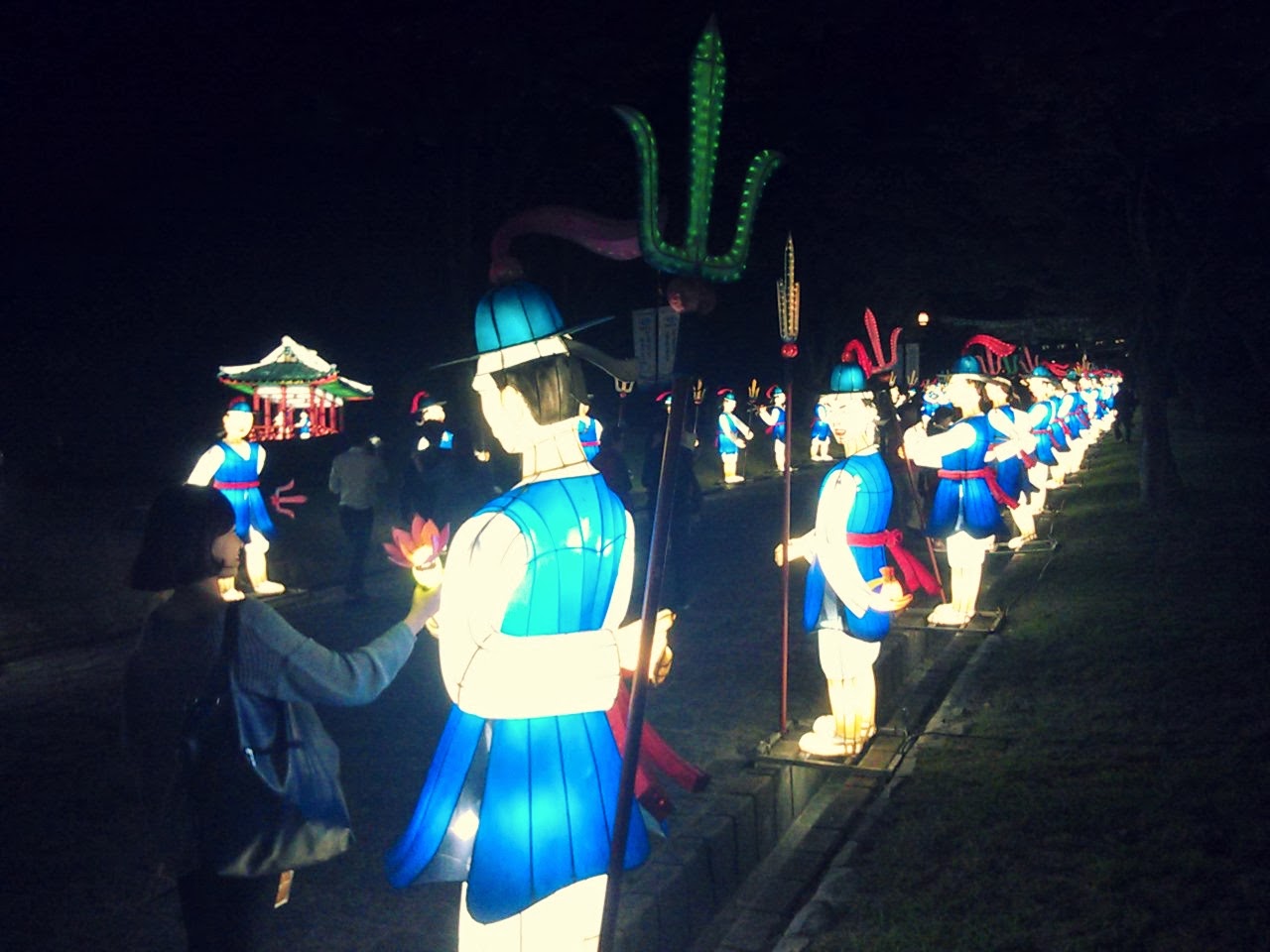
Monday to Wednesday at Shinpyeong Middle School this week were devoted to midterm exams. However, since I don't have to proctor or grade any exams this actually meant three days of freedom. Monday was spent recovering from Seoul. Tuesday I packed my bag again and set off to Jinju, a town 2 hours south of Gumi and host to a famous lantern festival. Though there are other lantern festivals in Korea this one stands out as both beautiful and historical; while under siege by the Japanese the people of Jinju placed lanterns in the river to prevent the Japanese from secretly fording the river at night.

The bus ride was, again, perfect for reading and on arrival in Jinju I easily met up with two other friends, Sophia and David. We got a late lunch at a local restaurant, delicious seafood kalguksu (a type of noodle soup) and a hot bibimbap which is a Jinju specialty. Then we wandered over the Jinju castle grounds which were full of lanterns depicting military battles, daily life in old Korea, animals and plants. There were so, so many I'm sure we only saw about half. Walking through the grounds it was like walking through a brightly lit picture book or a still movie.
The dancing cranes were by far my favorite.

David, myself and Sophia in front of the castle.
We had to walk up a hill to get to the castle and on the way back down we took another path which led us through the love tunnel. Literally, there is no other name for it. We stopped here to write our wishes on a ribbon, hoping all the good feelings in the love tunnel will help them come true.
My wish for this year.
After passing through the love tunnel we met up with another friend, John, who actually lives in Jinju. Together we sat down on the hill to watch the fireworks. The lanterns were amazing but they were nothing to the fireworks. The show began with five or six orange and white birds flying up into the night. They coasted so gracefully so that they almost seemed to be kites, but then each bird shot flames from its wings and sped off. This was the signal for the big fireworks and while these were standard fireworks they were stunning in their proximity. We were sitting just above of the river and when the first circle of light exploded everyone jumped. Then a waterfall of sparks began to flow off the sides of each bridge like a golden river. Soon more and more large fireworks were exploding in the sky and each spark seemed like it was about to run right up and kiss you. We could feel the ashes falling on us and I swear I saw someone showered in still-live sparklers. But with all this the noise as well. I feel as if this was the closest I will ever get to watching a star explode. Amazing. After it ended each one of us was stunned silent for a moment.

We were all getting hungry at this point and decided to cross the river in search of food. We quickly found more than we could handle in the giant marketplace, but were able to enjoy two more beautiful lantern tunnels on our way. In the end we sat at one of the food tents, talked and rested until we were about asleep on our feet. The night ended with my first stay at a love motel. 60,000 won for a two bed hotel room? I'll take it.

Windmill lantern, reminds me of the Netherlands.
View from the bridge. Not the best quality, but you can get the idea.
Lantern tunnel — these lanterns were all made (I think) by local children as each one was unique in design and skill level.
Me and 'The Kiss' lantern.
Giant dragon lantern.

This Friday is my first day back at school in a week, but it doesn't feel as if I was gone. I'm more surprised that it is October already. With midterms behind us and a new month ahead I want to take this weekend to map out some rigorous and exciting lesson plans for the rest of the semester. Especially as the weather starts to get chillier, sitting down with a hot drink and a large pile of work sounds more and more inviting.