Pages

Thursday, September 10, 2015

응답하라1994 ~ Answer Me 1994


One of my favorite dramas of all time is Answer Me 1994. I watched it first in the winter of 2013, soon after it first aired and again in 2014. Answer Me 1994 is a comedic, light-hearted drama that follows the growing pains of 7 young college students in 1994, all of whom recently moved to Seoul from the countryside. At that time Seoul was (as it still is now) the major city in Korea, but even more than now, other parts of the country were still relatively under-developed, lacking many of the western chains that are ubiquitous today.

One of the reasons I love this drama is that it is essentially nostalgic — it is meant to appeal to viewers who grew up in that time period and to evoke the decade when Korea (and the whole technology world) were changing rapidly. The drama does this masterfully and helped me understand where certain aspects of 21st century Korea have arisen from.

Although all the characters have entertaining storylines, the main plot revolves around Sung Na Jung (Go Ara) and her future husband. The drama involves a frame story set in 2013 in which Sung Na Jung has just moved to a new apartment. The doorbell rings and through the door camera we see all the members of Na Jung's college hasukjip (homestay or boardinghouse). In a voice over Na Jung tells the audience that one of the men below is her husband. From there on, each episode contains a small portion of the frame story and then flashes back to the characters' college days as they reminisce.

So what do I love so much about Answer Me 1994?
  • This is one of the best written dramas I have watched. The characters come off as natural, sometimes goofy and very likeable. There are no real villains and conflict comes mostly through the coincidences of life rather than any fatal misunderstandings.
  • Go Ara does amazingly well portraying the outspoken, passionate and sometimes insecure Na Jung. Sung Il Dong and Lee Il Hwa have wonderful roles as Na Jung's father and mother respectively. The rest of the main cast — Jung Woo, Yoo Yeon Suk, Kim Sung Kyun, Son Ho Jun, Baro (of B1A4) and Min Do Hee (of TinyG)— are all at times hilarious, pitiable and charismatic.
  • The drama provides a special glimpse into the Korea of the 90s. You can watch the rise of college sports and kpop with their respective fandoms, the feelings surrounding the IMF crash (when Korea declared bankruptcy) and the rivalry between Seoul and the other provinces.
This is one drama I can watch again and again and the characters and situations never get old.

Monday, September 7, 2015

WINTER VACATION: 11 days in Japan

Citron Ramen, Osaka
This winter after finishing my Korean course at SNU I had to return to school for one week in February as the 3rd grade students (9th grade in the U.S.) graduated from middle school. After moving back into my apartment in Daegu and saying goodbye to my wonderful 3rd graders it was off again to meet my friend, C, in Cheonan (a city right below Seoul) before traveling to Japan together.

We had scheduled 11 days there during what is known in Korea as 'spring break' — a three week period after graduation and before the start of the new school year in March. We chose to purchase the Japan Rail Pass as we wanted to see as much as possible without worrying too much about transportation. It was absolutely worth it and easily paid for itself during our time there. We bought the 14 day pass and I highly recommend it to anyone traveling in Japan. The high speed trains were efficient, clean and comfortable and with the rail pass we could choose to reserve a seat on trains going almost anywhere in Japan or simply show up and find a seat in the unreserved car. This saved us a lot of time and we never had to worry about getting seats or missing our train. The only drawback was reserving tickets which had to be done at a Japan Rail train station, but even there the staff were very helpful. Finally, the pass also let us ride free on city subway lines owned by Japan Rail in Kyoto and in Tokyo — a huge time and money saver.

Our schedule was split into several sections:

  • First, we arrived in Osaka (Kansai Airport) and took the train that night to Kyoto. We spent 3 nights and 2 full days in Kyoto, leaving on the 3rd day for the south.
  • From Kyoto we took a variety of trains to reach Tadanoumi a tiny town above Hiroshima from which we could take a ferry to Okunoshima, also known as rabbit island.
  • After visiting rabbit island, we continued on to Hiroshima where we spent 2 nights and 1 full day. 
  • From Hiroshima we took the high speed train north to Yokohama (the second largest city of Japan, which sits just below Tokyo). There we met a friend of C's who was enrolled in a year-long intensive Japanese program at the language institute there. We spent 3 days in Yokohama and Tokyo.
  • Next we took the train north-west to Nagano where we caught a further, local train followed by a bus to Shibu Onsen, a traditional onsen (hot spring bath) resort town. We stayed there just one night, making time to visit Jigokudani Yaenkoen, the only place in the world where monkeys relax in hot springs, and time to enjoy the hot spring-fed baths ourselves. 
  • We returned to Yokohama and Tokyo for just one day before heading back to Osaka to complete our trip.
The trip was a lot of fun and a good balance between seeing the history, pop culture and natural features of Japan. I will focus in on a few of the highlights in further posts.

Friday, September 4, 2015

프로듀사 ~ PRODUCER


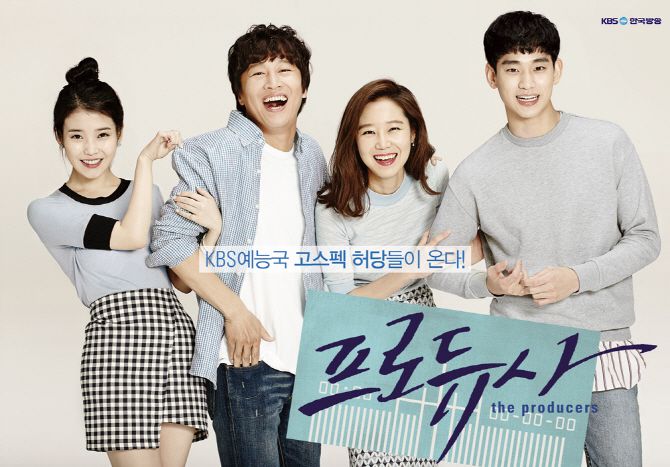
This summer I took the opportunity to watch the star-studded drama, Producer, which came out in the late spring of this year. The story follows Baek Seung Chan (Kim Soo Hyun) a rookie in the variety department at KBS, Tak Ye Jin (Gong Hyo Jin) the producer of Music Bank, Ra Joon Mo (Cha Tae Hyun) the producer of 1 Night, 2 Days and Cindy (IU) a popular singer as their professional (and love) lives overlap.

The story opens with the slightly clueless Baek Seung Chan who followed his college crush to KBS's variety department, only to discover on his first day that she is dating one of his sunbaes. At the same time, Tak Ye Jin, famous in the variety department for her temper, is having money troubles and dented a car on the way to work, but can't get in touch with the owner all day. Not only that, the star Cindy, who is appearing on Music Bank that evening refuses to change out of a risque outfit. Ra Joon Mo is having troubles of his own: his show ratings have reached the lowest of the low and the rumor is going around that 1 Night 2 Days will be cancelled very soon.

By the end of the first episode we discover that the car Tak Ye Jin hit is in fact Seung Chan's car, the man dating Seung Chan's crush is Ra Joon Mo, who's show is, in fact, getting cancelled and Joon Mo is actually Ye Jin's childhood friend and POTENTIAL SPOILER: roommate.

If you noticed I didn't mention IU too much it's because she doesn't figure too heavily in the opening of the story. At its core, Producer is a drama about growing/changing relationships, especially in the face of the media and media culture. Cindy (IU), is cold, isolated and overworked. At the age of 23 she has been active in the industry for 10 years and has no friends. Over the course of the drama she struggles with all these issues and we could say her coming of age is the main storyline.

In fact, there are many different main storylines all of which are roughly equally balanced within the drama. For some people, especially those who prefer to watch only the main romance, this could be a drawback to Producer. The show is somewhat experimental within the kdrama genre and did not do as well in Korea as the popularity of the main actors/actresses might have predicted.

However, there are many things to love about Producer as well:

  • The four main stars (Kim Su Hyun, Gong Hyo Jin, Cha Tae Hyun and IU) all had wonderful performances. As a group the actors had wonderful chemistry resulting in some very hilarious scenes in which Gong Hyo Jin and Kim Su Hyun perform their best (or possibly worst) aegyo. 
  • The drama is FULL of cameos. Even many very small characters are easily recognizable stars. Just trying to find out who's who and get in on the joke can be a lot of fun. Look for Girl's Generation, JYP, Hani of EXID, Dara of 2NE1, Kang Seung Yoon of Winner, Lee Seung Gi and many others.
  • You get to peek into the world of Korean variety television. All of the work scenes are filmed right in KBS and the scenes in which the producers come up with ideas, test-run games and edit the raw footage are often hilarious, while being true to life.
  • Again, the actors really made the drama. Besides that, the show only lasts 13 episodes and who doesn't have time for that?

Tuesday, September 1, 2015

JANUARY 2015: Seoul National University

I began the new year by moving to Seoul for a month of language training at Seoul National University, Korea's highest ranking universities and one of the 'SKY' schools (SNU, Korea U, Yonsei U) to which high school students aspire. There are a wide range of options for Korean classes in Seoul, but I chose SNU due to its January schedule and a friend's recommendation.

Seoul National University Campus
Winter sunrise on our way to class
Overall I was pleased with the rigor and organization of the course. There were around 10 people in my class from a wide range of countries, some living in Korea and others visiting just for this class. We met five days a week from 9:00 - 1:00. Everyday we covered a chapter of the textbook, each of which included 3-4 grammar points. That means over the course of our 3 weeks we covered: the entire textbook, 6o hours of class time and ~24 grammar points. During this time we were required to complete daily homework and quizzes, write and perform two dialogues, write and perform a five minute presentation and a final written and oral exam. We were kept constantly busy by the class hours and homework — so much so that I believe it took the rest of the semester for all the lessons learned to sink in.
Our group photo at the final class of the course. Our teacher gave us all little captions. Mine says: Korean is easy! (If only, haha...)

Me and oori seonsaengnim (our teacher)
In the meantime, my friend and I were sharing a small one-room apartment in 고시촌 (goshichon), literally a village of goshiwons (cramped, cheap rooms often rented out to students and those preparing for tests). Our building sat at the top of a steep hill, so steep that when it iced over, as it does in the winter in Seoul (it was a horrible cold winter) it was almost impossible to walk up or down. Still, we were in a mecca of cheap food and warm cafes. Every morning we took the bus 15 minutes to SNU and after class, took the bus another 15 minutes to the Seoul University Subway Station. Conveniently located on Seoul's circle line, the green line, the subway could take us anywhere we wanted to go (usually, after class, to lunch).

Looking down the hill, just try to glimpse the end
Half the reason I chose to do this course was my desire to live in Seoul, just for one month. I wanted to be a Seoulite, a Seoul saram (Seoul person). Instead of taking a vacation in Seoul I really felt like a student, finding time to cross the city and meet friends between homework sessions and late dinners. I was happy to see Yumin several times during this month. Together we traveled all the way into the suburbs to visit the set of 별에서 온 그대 (Byeol eseo on geudae, My Love from the Stars) a wildly popular Korean drama from the winter before. Although parts of the exhibit were campy, being able to walk through the luxurious set apartments (actually used in the drama) was a lot of fun.

In Do Min Joon's apartment, sitting where Kim Su Hyun sat


I also got to know some of the students in my Korean class and together we went to our first cat cafe! It was amazing to meet such a global group, all learning Korean for very different reasons. Some people were there for school, others for vacation, for their job or even because they were married to someone Korean.


Sunday, August 30, 2015

NEW YEAR ARRIVING

December 31, 2014

Homigeot Beach, Pohang
I woke up at 4am in a motel near the bus terminal in Pohang, an industrial harbor city on Korea's eastern coast. I had arrived the night before after finishing my last day of work before the holidays. My friend who I was traveling with had come to Pohang a few days before to visit the school where she taught the year before.

Pohang's most famous feature is a statue of two hands, one on the land, one in the water, reaching out towards each other across space. Located at the easternmost jut of the eastern coast, every year hundreds of people swarm the area, even camping out, to see the first sunrise of the new year filtered through the statue's fingers.


That morning we hopped in a taxi, joining a long line of cars all heading to Homigeot, the little edge of land where the sunrise festival is held. We were both exhausted from our schedules and the taxi driver kept telling us how overcast it was, that we wouldn't be able to see anything anyways. Eventually the cars came to a halt and the driver dropped us off on the stand-still highway. All around us people wearing layers of hats, coats and blankets were streaming out of cars, walking in a long procession along the road to the shore.

It was still dark then, with only a hint of light filtering over the horizon, and bitterly cold. My friend and I had dressed in long underwear, wool socks, leggings, sweaters, coats, scarves, hats and gloves, but the sharp winds along the embankment ripped through everything. Impossibly, the winds came from every direction, threatening to tear off blankets, scarves and knock children over.

As we approached the main square where the statues were the space became ever more crowded. Here we saw families who had rigged their vans and cars as sleepers and spent the night there, waiting. There were even some tents, though I have no idea how they could have stayed warm enough through the night.

The main square was too crowded and instead we wandered down onto the embankment rocks where we could settle in and have a clear view of the lightening sky. Around us people were singing, talking, yelling. Ours toes went numb and our eyes kept watering in the wind. Suddenly, the sky became blindingly bright as the sun split off from the sea. The clouds our taxi driver had chided us about had cleared away. A countdown rippled across the hundreds of people gathered on the coast and the sun rose.


Eventually everyone dispersed — to cars, to restaurants, to events happening in the park. My friend and I ran into a restaurant to de-thaw with a huge haemul jjim, spicy steamed seafood. Torn up by the wind, by our tiredness, the rest of the day was very quiet. We stayed at the beach until well into the afternoon getting coffee on the second floor overlooking the sea. The other families and couples around us seemed in quiet good spirits as well, taking selfies at the window and unwinding.

In Korea, as in other places, you make a wish for the new year. I don't remember now what I wished for seeing those first few rays, but I feel whatever it was, it has been fulfilled in so many ways through the time I had this spring, time to relax, explore and build friendships without the pressure of the future.


Saturday, August 29, 2015

to long (for) — it has been too long

The winter and spring of 2015 passed in a flurry of deadlines (grad school apps, magazine articles, Korean tests) and now the summer is dashing to a close as well. Here in Boston I miss the hot, hazy evenings of Daegu — the interminable summer. I completed my Fulbright grant on July 17th, 42 days ago. I left Korea on the 26th, but only in the last few days have I begun to feel an ache at the thought of a warm bowl of seolleung-tang, at photos of my students picking their noses on facebook, at the posts on this blog, recalling for me the very start of my journey.

On July 17, 2013 I wrote about listening to Big Bang for the first time. Almost two years later, in April of 2015 I saw Big Bang perform live at Seoul Olympic Stadium. So many memories — of meeting my host family for the first time, minor existential crises along the way and budding friendships that have since flowered. 

Looking back on my last blog post it has been almost a year since I went AWOL. So many significant moments have happened since then, moments that shaped my experience of Korea. Instead of moving on immediately to my new life in Boston, I hope to retrospectively bring this blog up to date, both as a way of recording and processing my memories. 

Even though I have left Korea now I continue, out of habit, to translate my thoughts into Korean. Reading through my old blog posts today the word that came to my mind was 그립다 (geuribda)— to miss, to long (for), to be homesick (for). Geuribda can apply to a place, to a person or even a time. 그레서 (geureseo, therefore). 학생들이 그리워요. 한국이 그리워요. 한국에 했던 시간이 그리워요. (I miss my students. I am homesick for Korea. I long for the time I had there.)

Saturday, October 11, 2014

DISCO PANG PANG

I know I recently wrote a very long post, trying to bring this blog up to date after my summer lethargy. However! I couldn't wait a decent amount of time to tell you about Disco Pang Pang because it is just too good. Just listen to the name.

The first time I heard Disco Pang Pang I thought it was the least descriptive Konglish name I'd yet encountered. Actually, once you have seen a Disco Pang Pang you know that it is exactly as it sounds.

Disco Pang Pang is a phenomenon hidden in the alleys of every Korean city from the suburbs to the Seoul. An arcade hall filled a single heavily padded and colored amusement ride. Middle to High School girls flock here to pay 4,000W (about $4) to spend rather too long bouncing and spinning to everything from Disco to Kpop. It's a pretty traditional amusement ride except that there are no seat belts and the main job responsibility of the workers seems to be to tease the customers with witty (or not so witty) banter.

I swear all the workers were cackling as a large group of foreigners wandered into the Disco Pang Pang arena. The whole thing was hilarious and oddly fun. We sat on the couch-like seats along the edge of the circular Pang Pang and held on tightly to the surrounding railing as it spun and bounced. The name made a lot more sense as people went flying, pang! pang! pang! into the air. The ride conductor, almost definitely a high school student, kept stopping the ride to interview us — "Where are you from? What is your name? Very handsome." My name must have been easy to remember because I spent the rest of the ride listening to cries of "Josepin! I love you!" Probably one of the more bizarre experiences I have had so far. Of course that doesn't mean I'm not going back.